

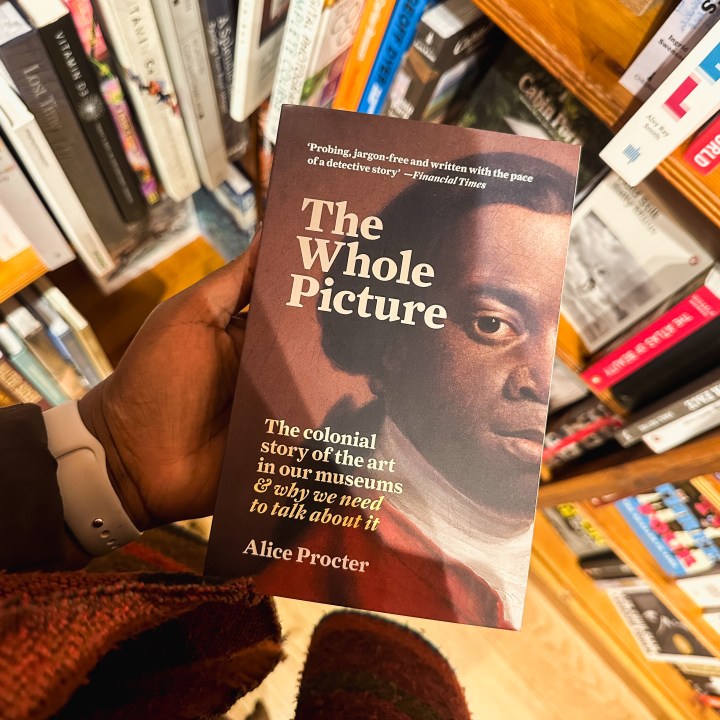
The Whole Picture: The colonial story of the art in our museums and why we need to talk about it by Alice Procter; Published by Octopus Books 2020
“We’re taught that [European] museum spaces are neutral: that they represent the world from an ‘objective’ point of view. But we have been lied to”
I really enjoyed listening to the audiobook- this was the first book I finished in 2025. While I do read articles, I haven’t really read many books on art theory/ history and this has definitely increased my curiosity.
I think (I hope) its common sense to question any media or collection you are presented with. It goes for books, it goes for movies, it goes for exhibitions. Who has curated the exhibition? who has paid for it? What are they trying to say and why? Whose voice/ art has been excluded and why?
Alice Proctor (art historian and the creator of Uncomfortable Art Tours) encourages us to interrogate what we are seeing in museum curation. To “make trouble” in our challenge of colonialism: “We’re taught that [European] museum spaces are neutral: that they represent the world from an ‘objective’ point of view. But we have been lied to”
The book is divided into four sections, categorising four different kinds of art space: The Palace, The Classroom, The Memorial and The Playground. Each of these categories explores motivations behind different types of exhibition- particularly in respect to forced colonial narratives.
I really appreciated this split – it gave a well considered, accessible framework to organise thoughts around colonialism in museums/ galleries. I also learned a lot about the origins of some famous institutions (The Louvre, British Museum etc) and specific, popular artefacts.
The Palace- Exhibitions formed largely from private collections of powerful people (often an aristocrats or royals) – in an attempt to shape the taste of elite audiences who in turn tend to influence general public. There’s a long running history of aristocracy using philanthropy in museums and galleries to clean up their image. The Sacklers and related protests come to mind (there’s a good section of Empire Of Pain dedicated to this). I also found this principle of shaping taste interesting- essentially this is what most curation is but the motives and the “who” should be factored into whether the palace principle applies-I’m thinking of underrepresented curators/donators sharing their collections to uplift underrepresented artists.
The Classroom- interrogates Museums as a didactic space- who gets to design the syllabus and what do they want us to believe ? An interesting example here was how often we hear about William Wilberforce as an “emancipator” when much more focus should be put on what enslaved people did to emancipate themselves. How are the organised uprisings and rebellions only a secondary conversation?? If not for Caribbean oral traditions and texts such as CLR James The Black Jacobins, how much of this history would be lost? Explores preferred, deceptive narrative about Britain and racism
The Memorial- Museums as spaces for remembrance with consideration around what respect is given to indigenous human remains. How has their trauma and burial tradition been considered, if at all? An example given is the mokomokai, which are still being held by museums. These are sacredly mummified heads of Maori people, which were then traded by non-Maori people for tools and weapons.
The Playground – highlights the work of contemporary artists reinterpret (often with humour) historical artefacts and stories that have come before them. I was particularly interested in Kara Walker’s Sugar Baby, because I remember hearing a lot about “A Subtlety” exhibition some years back. If you type the hastag KaraWalkerDomingo into IG, you’ll still see a lot on it. Another point about The Whole picture is that Alice Proctor (briefly) addresses the impact social media has on curation. It cant be ignored at this point. She also references We are Here and The White Pube here.
Alice Proctor does on a number of occasions acknowlege her limitiations of perspective herself, noting that she’s a white woman whose own country has benefited from colonialism and manipulation of narrative through arts. I would love to read more on the topic of art and colonialism from Black, Asian and writers across the diaspora.
I’m particularly excited to read Reframing Blackness: What’s Black about “History of Art”? by Alayo Akinkugbe (Merky Books). Published in July 2025 and explores the presentation of Black figures in Western art, as well as Blackness in museums, in feminist art movements and in the curriculum, I’ve been listening to a few episodes of her podcast A Black History of Art Presents A Shared Gaze.
The writing and explanation in The Whole Picture is very accessible, I’m no art historian or any sort of post colonial expert and found this very readable/ listenable. I look forward to reading more books that investigate how we are presented with and consume art, how art is curated for us and purposes. Any recs?

 Paperback Social
One thought on “The Whole Picture by Alice Proctor: Book Review”